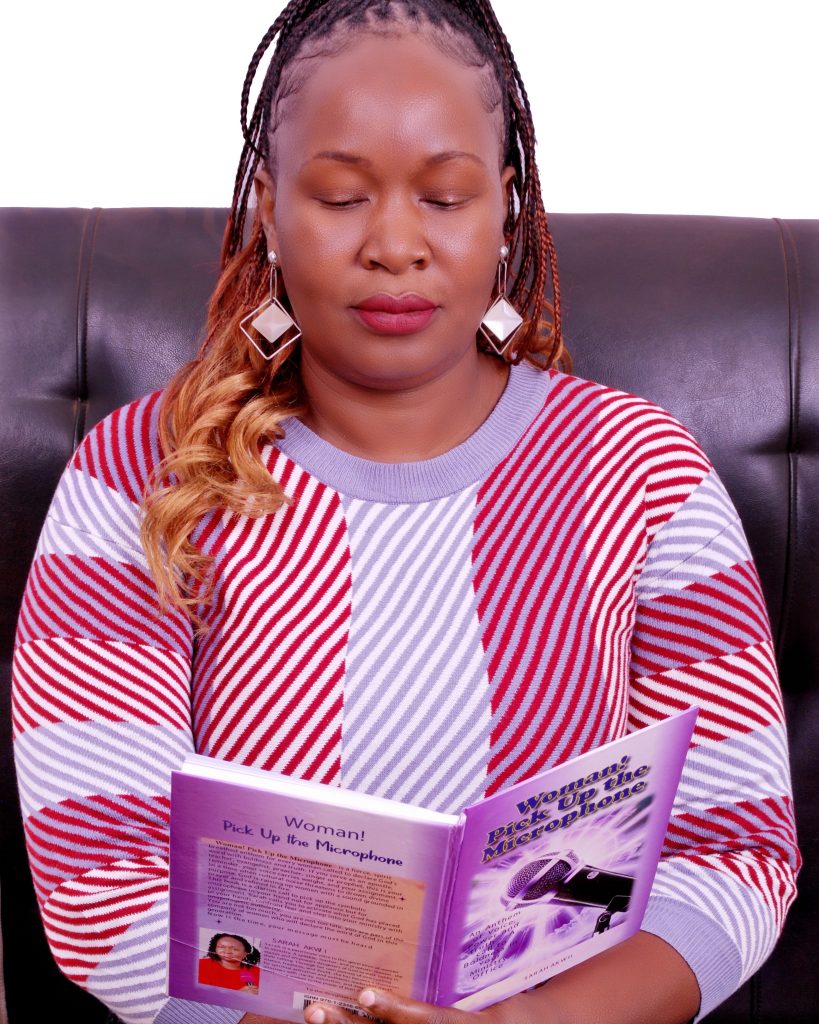
Woman! Pick up the Microphone.

The Announcement!

She held the draft in her hands—and smiled. What began as a whisper from heaven is becoming a voice for generations.
Woman! Pick Up the Microphone is coming soon!
Your silence was never your story. Your sound carries healing. But first, Let me introduce to you this book!

There is a sound rising in the Spirit—a sound that carries healing, authority, and revival. It is the sound of a woman who has discovered her voice.

For too long, many of us have carried a word but lacked the courage, language, or permission to release it. We have been present but quiet, anointed but hidden, called but uncertain. Yet Heaven is issuing a call in this generation:
“Woman, pick up the microphone.”

This is not just about a stage, a pulpit, or a platform. It is about obedience—saying yes to God in whatever space He places you. It’s about realizing that your voice carries deliverance, your story carries truth, and your presence carries light.

In this book, you will journey through the process of finding, protecting, and releasing your God-given sound. You will meet biblical women who broke silence with faith, and modern-day women who are stepping out in courage. You will be reminded that ministry begins not when the world applauds you, but when you obey the whisper of God.

I write this as a woman who once doubted her own sound—who thought her “yes” needed permission. But I have learned that when Heaven calls your name, no earthly silence can hold you back.

So to every woman reading this:
Your voice matters.
Your story carries power.
Your sound is needed now.

This is your time to rise, to speak, and to shine.
This is your invitation to pick up the microphone.

Don’t miss out!!

Finding Strength and Purpose in the Wilderness.

In a biblical context, the “wilderness” often carries a literal and symbolic meaning. Literally, it refers to a desolate, uninhabited, and often harsh environment, such as a desert or barren land. Spiritually, the wilderness represents a place or season of testing, purification, and reliance on God.

Throughout Scripture, the wilderness is where many significant events and lessons occur:

  • It is where God tests and refines His people, teaching them trust and dependence on Him (e.g., the Israelites’ 40 years in the wilderness in Exodus and Numbers).
  • It symbolizes isolation and preparation, as seen in the lives of individuals like Moses, Elijah, and even Jesus, who spent 40 days in the wilderness fasting and resisting temptation (Matthew 4:1-11).
  • The wilderness is also a place of transformation, where people often encounter God in profound ways, leading to spiritual growth and renewal.

While it may seem like a place of difficulty or challenge, the wilderness is often depicted as a time when God is especially present, guiding, providing, and strengthening those who put their faith in Him.

There are several women in the Bible who faced significant testing and challenges that shaped their faith and purpose. Here are a few notable examples:

  • Sarah endured years of barrenness, longing for a child. Her faith was tested as she waited for God’s promise to be fulfilled. Ultimately, she became the mother of Isaac, demonstrating God’s faithfulness.

2. Hagar (Genesis 16 & 21)

  • As Sarah’s servant, Hagar faced rejection and hardship, fleeing into the wilderness. Her encounter with God at a spring in the desert is a powerful reminder that He sees and cares for those in distress.

3. Ruth (Book of Ruth)

  • After losing her husband, Ruth chose to stay with her mother-in-law Naomi and embraced an uncertain future. Her loyalty and faith led to redemption and a place in the lineage of Jesus.

4. Esther (Book of Esther)

  • Esther risked her life by approaching the king without being summoned, to save her people from destruction. Her courage during this trial demonstrates reliance on God and the importance of bold action.

5. Hannah (1 Samuel 1–2)

  • Hannah faced infertility and ridicule from others but persevered in prayer and faith. God blessed her with Samuel, who became one of Israel’s great prophets.

6. Mary, the Mother of Jesus (Luke 1–2)

  • Mary faced immense societal scrutiny and uncertainty as she accepted her divine role to bear the Messiah. Her unwavering trust in God through this extraordinary test is inspiring.

These women’s stories highlight themes of resilience, faith, and the transformative power of trusting in God during seasons of testing.

Depend on God’s Guidance

Hagar: When Hagar fled into the wilderness, God provided guidance and reassurance. Genesis 21:17-19 highlights God’s intervention: “God heard the voice of the boy…Then God opened her eyes, and she saw a well of water.”

Esther: Though not a literal wilderness, Esther faced uncertainty as she approached the king. She depended on God for guidance and courage. Esther 4:14: “…who knows whether you have come to the kingdom for such a time as this?

Learn to Listen

Mary, the Mother of Jesus: Mary humbly listened to the angel’s message about her role in God’s plan (Luke 1:26-38). Her attentive heart allowed her to embrace the profound calling with grace and trust.

Hannah: During her wilderness of barrenness, Hannah prayed fervently and listened in faith, trusting that God would answer her (1 Samuel 1:9-20).

Stay Humble and Teachable

Ruth: Ruth’s humility and willingness to learn from Naomi led her to Boaz and ultimately to her purpose in God’s plan. Ruth 2:2: “Let me go to the field and glean among the ears of grain.”

Miriam: Miriam learned humility and dependence on God after her challenge to Moses’ leadership. Numbers 12:1-15 recounts her experience and God’s correction.

Focus on Daily Provision

The Widow of Zarephath: God provided for this widow during a famine through Elijah’s visit. Her faith resulted in a miracle of daily provision. 1 Kings 17:14: “For thus says the Lord, the God of Israel, ‘The jar of flour shall not be spent, and the jug of oil shall not be empty.’”

Mary Magdalene: Mary Magdalene found daily sustenance for her soul through Jesus’ teaching and presence (Luke 8:1-3).

Hold onto the Promises of GOD

Sarah: Despite waiting decades for God’s promise of a son, Sarah’s faith eventually brought fulfillment. Hebrews 11:11: “By faith Sarah herself received power to conceive, even when she was past the age…”

Elizabeth: Elizabeth trusted God’s promise as she carried John the Baptist in her old age. Luke 1:24-25: “Thus the Lord has done for me in the days when He looked on me, to take away my reproach among people.”

Build Strength in Community

Ruth and Naomi: Their relationship strengthened them during the wilderness of grief and loss. Ruth’s loyalty brought hope and renewal for both. Ruth 1:16: “Your people shall be my people, and your God my God.”

Deborah: As a leader and judge, Deborah worked with Barak and the Israelites to overcome adversity. Judges 4:8-10 shows the power of collaboration and community.

Each of these women demonstrates how to navigate a wilderness season with faith, humility, and perseverance.

    Vulnerability and Power Dynamics

    Who was Bathsheba?

    Bathsheba was a woman of wisdom (an incubator of greatness), faith and resillience but was voiceless!

    2 Samuel 11-12. Narrates her encounter with King David, which begins when David sees her bathing and sends for her. This leads to a series of events, including her pregnancy, the arranged death of her husband Uriah, and the eventual confrontation of David by the prophet Nathan. Bathsheba later becomes the mother of Solomon, who succeeds David as king

    Bathsheba’s character, as portrayed in the Bible, is multifaceted and evolves over time. Here are some key aspects:

    1. Resilience: Bathsheba endured significant challenges, including the loss of her husband, Uriah, and her first child with David. Despite these hardships, she remained strong and played a pivotal role in the royal lineage as the mother of Solomon.
    2. Wisdom and Influence: Later in her life, Bathsheba demonstrated wisdom and political acumen. She successfully advocated for Solomon to become king, showcasing her influence within the royal court.
    3. Faith and Redemption: Bathsheba’s story is one of redemption. Though her life was marked by sin and tragedy, she became an integral part of God’s plan, as her son Solomon carried forward the Davidic line, leading to the lineage of Jesus Christ.
    4. Quiet Strength: In much of her story, Bathsheba is portrayed as a quiet figure, swept along by the actions of others, particularly King David. However, her later actions reveal a woman of strength and determination.

    Powerlessness and vulnerability likely shaped Bathsheba’s inability to resist the circumstances imposed upon her. In her encounter with King David, the dynamics of power were starkly imbalanced. As a woman in that historical context, her ability to challenge the king’s actions would have been incredibly limited, both socially and politically. This highlights the broader theme of how societal structures can strip individuals, especially women, of agency and voice.

    Bathsheba’s story reminds us of the enduring need to advocate for empowerment, fairness, and the creation of spaces where vulnerability does not lead to exploitation. It challenges us to reflect on how we can amplify the voices of those who feel powerless in our modern context, whether in workplaces, communities, or broader societal structures.

    A modern-day Bathsheba, facing vulnerability in a situation involving power dynamics, temptation, or ethical dilemmas, can benefit from thoughtful and faith-based guidance.

    1. Anchor Yourself in Faith: Seek strength and clarity through prayer, scripture, or spiritual practices. Trust in God’s guidance to navigate challenges with integrity and wisdom. Proverbs 3:5-6: “Trust in the Lord with all your heart, and do not lean on your own understanding. In all your ways acknowledge Him, and He will make straight your paths“.
    2. Recognize Your Worth: Understand that your value is not defined by external circumstances or the attention of others. Embrace your identity as someone created with purpose and dignity. Psalm 139:14: “I praise you, for I am fearfully and wonderfully made. Wonderful are your works; my soul knows it very well.”
    3. Set Boundaries: Establish clear personal and professional boundaries to protect yourself from situations that may compromise your values or well-being. Proverbs 4:23: “Keep your heart with all vigilance, for from it flow the springs of life.”
    4. Seek Wise Counsel: Turn to trusted mentors, spiritual leaders, or supportive friends for advice and encouragement. Proverbs 11:14 reminds us, “Where there is no guidance, a people falls, but in an abundance of counselors there is safety.”
    5. Focus on Long-Term Impact: Consider the consequences of your choices, not just for yourself but for others involved. Strive to act in ways that align with your principles and honor your commitments. Galatians 6:9: “And let us not grow weary of doing good, for in due season we will reap, if we do not give up.”
    6. Practice Resilience and Forgiveness: Challenges may test your strength, but resilience and a forgiving heart can help you move forward with grace and peace. Colossians 3:13: “Bearing with one another and, if one has a complaint against another, forgiving each other; as the Lord has forgiven you, so you also must forgive.”
    7. Trust in Redemption: Remember that mistakes or vulnerabilities do not define you. God’s grace offers redemption and the opportunity to grow stronger through life’s trials. Romans 8:28: “And we know that in all things God works for the good of those who love Him, who have been called according to His purpose.”

    Bathsheba’s story invites us to reflect on vulnerability, power dynamics, and the transformative role of faith in navigating challenges. Her journey, from powerlessness to becoming a key figure in Solomon’s ascension, offers timeless lessons on resilience, redemption, and purpose.

    As we examine her narrative, we recognize the complexities of human emotions and the grace of divine intervention. What insights do you find most relevant to today’s challenges? How can Bathsheba’s experiences inspire us to empower others and act with integrity?

    We welcome your thoughts, reflections, and ideas in the comment section. Let’s explore together how her story speaks to our modern struggles and triumphs. Your contributions are invaluable to enriching this dialogue!